
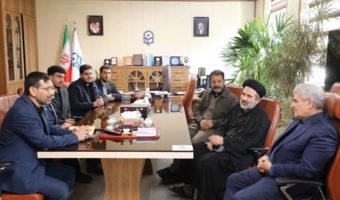
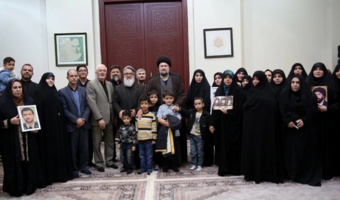
Think Tank Meeting of the National Headquarters for Prayer with Members of the Board of Trustees of Farhangian University Held

According to the Public Relations Office of the Central Organization of Farhangian University, Mehrzad Hamidi, President of Farhangian University, at the consultative meeting of the National Headquarters for Prayer with members of the Board of Trustees of Farhangian University, while expressing gratitude for the blessed presence of Hojjat al-Islam wal-Muslimin Qara'ati and his continuous guidance in the country's education system, stated: "If the issue of prayer has been developed in education and the country's education system, one of the main and encouraging factors is the blessed presence and decades-long efforts of Professor Qara'ati, who has dedicated his life to promoting Qur'anic teachings."
Referring to the measures taken in recent months to implement the provisions of the Charter for the Establishment of Prayer at Farhangian University, he noted: "Despite spatial and structural limitations in some educational centers that are inheritors of old student dormitories, fortunately, all educational centers of Farhangian University across the country have prayer rooms, and congregational prayers are held with the presence of student teachers."
The President of Farhangian University added: "Based on the resolution of the Supreme Council of the Cultural Revolution regarding the establishment of comprehensive provincial universities in all provinces, the movement for land acquisition and infrastructure development has begun in cooperation with governors, and groundbreaking and construction ceremonies for comprehensive provincial campuses are underway. With the realization of this important matter, standard mosques similar to those of other universities in the country will be built at comprehensive provincial universities."
Referring to the continuous activity of prayer leaders and the Office of the Supreme Leader's Representative at the university, he stated: "Currently, more than 100 prayer and Qur'an centers are active in the educational centers of Farhangian University."
Hamidi, emphasizing the implementation of the legal obligations of the Seventh Development Plan regarding Qur'anic education for student teachers, stated: "The law had obligated Farhangian University to cover 50,000 student teachers annually under Qur'anic education; but with the efforts of the Deputy for Cultural Affairs and the diligence of the centers, in the current semester and following the resumption of in-person classes, more than 102,000 student teachers have been covered by Qur'anic literacy programs and education, which indicates the university's leadership in implementing legal obligations."
Referring to the adoption of a transformative approach at Farhangian University, he said: "Recently, the programs for the school management course and the non-continuous bachelor's degree in elementary education were approved. Given that about 50 percent of our student teachers are studying in the elementary education field and the core of transformation in the education system begins with elementary schools, special focus has been placed on strengthening specialized and Qur'anic education for this group of student teachers."
In continuation of this meeting, Hojjat al-Islam wal-Muslimin Qara'ati, Head of the National Headquarters for Prayer, while reviewing his 60 years of teaching experience, stated: "Work that is formed based on sincerity and willpower does not require massive budgets and the issuance of laws. I began teaching in an abandoned mosque for seven teenagers."
He continued: "In an era when it was thought that the pulpit was only for adults and in the form of long speeches accompanied by mourning and sorrow, I went to the blackboard and began working for children and teenagers."
The Head of the National Headquarters for Prayer, stating that the Holy Qur'an mentions laughter before crying, said: "The Holy Qur'an states: 'And that it is He who makes [one] laugh and weep.' If we want the new generation to accept our message, speeches must be short, concise, and accompanied by laughter and cheerfulness."
Hojjat al-Islam wal-Muslimin Qara'ati, distinguishing the teaching mission from other specialties, emphasized: "All engineers and scientists work on inanimate objects, but the only person who directly influences humans is the teacher. Therefore, appropriate facilities must be provided to Farhangian University."
Stating that there is no concept called graduation in Islam, he emphasized: "In the school of Islam, there is no meaning for graduation; if there were, God would not have commanded the Noble Prophet of Islam to say, 'My Lord, increase me in knowledge.' A teacher must be in a state of knowledge acquisition and enhancement of understanding until the last moment of life."
The Head of the National Headquarters for Prayer, pathologizing superficial behaviors in the name of cultural work, said: "Many seemingly scientific topics, instead of solving problems, are clear examples of useless and harmful sciences and are not cultural work. Culture means implementing the messages and practical principles of the Qur'an in daily life."
Emphasizing that teachers should not suffice with general lecturing in class, he stated: "People have different spiritual characteristics; sometimes guidance in one form is not possible for everyone, and individualized educational approaches must be adopted. A successful teacher is one who discovers young people and, if necessary, applies individualized guidance and support for them."
Hojjat al-Islam wal-Muslimin Qara'ati, stating that the courage to admit not knowing is a great moral lesson for classrooms, reminded: "If a student asks a question whose answer we do not know, we should not evade. Saying an honest 'I don't know' from a teacher is the highest educational lesson. Allameh Tabataba'i, with all his scientific greatness, when he did not have an answer, would say with
The Head of the National Headquarters for Prayer, recalling the manner of the great scholars in confronting doubts, said: "Responding to doubts must be persuasive, scientific, and based on rationality."
Hojjat al-Islam Qara'ati considered true friendship between teacher and student and the creation of an emotional relationship as influential factors in education and, recounting a memory, added: "A professor who, in the intense heat of Kashan, placed wet sacks on his students' shoes so their feet would not burn, had a profound educational impact on his students. A teacher must be sincerely compassionate toward children from the depths of his soul. A classroom is not just a lesson; it is these emotional manifestations that conquer the hearts of young people."

Your Comment :