
Secretary of the Supreme Council of the Cultural Revolution Emphasizes Support for Farhangian University
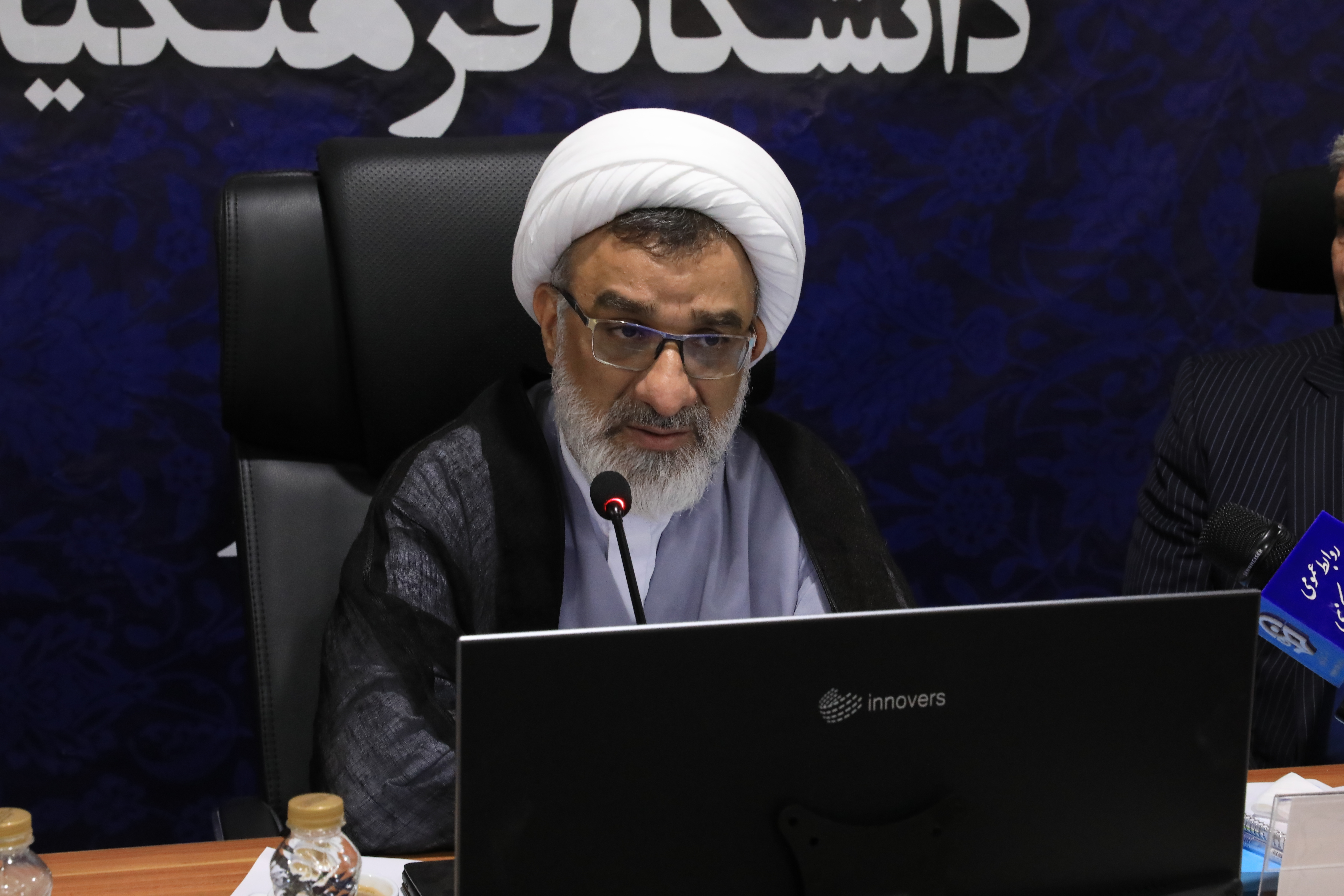
Hojjat al-Islam Abdolhossein Khosropanah, Secretary of the Supreme Council of the Cultural Revolution, addressing faculty members, managers and heads of Farhangian University centers from across the country, outlined the Council’s practical support for the university, highlighted the significant growth in relevant resolutions in recent years, and emphasized the country’s firm commitment to enhancing the quality of teacher education.
According to the Public Relations Office of Farhangian University, quoting the Media and Public Relations Center of the Supreme Council of the Cultural Revolution, Khosropanah expressed his appreciation for the efforts of Alireza Kazemi, Minister of Education, and referred to the particular attention paid by senior national officials to education and teacher development. He said that he had had the honor of working with the late President Ebrahim Raisi as well as President Masoud Pezeshkian, noting that Raisi had deep concerns about education and that President Pezeshkian, through his personal participation in more than 50 related meetings, had demonstrated an exceptionally high level of commitment to the field.
The Secretary of the Supreme Council of the Cultural Revolution also expressed his appreciation to all founders, presidents and staff members of Farhangian University, particularly Mehrzad Hamidi, whom he described as diligently following up on the university’s affairs. He noted that Hamidi is one of the key members of the Council’s Education and Training Headquarters and actively participates, with voting rights, in matters concerning the broader education system, not merely Farhangian University.
Referring to the recent message of the Supreme Leader, Khosropanah emphasized the importance of maintaining consistency in the discourse and conduct of officials. He stated that even well-intentioned language can undermine collective unity if it causes division, whereas pursuing unity brings greater effectiveness and success to collective efforts.
Khosropanah stressed that the Council’s support for Farhangian University has not been merely rhetorical, but has been reflected in concrete and continuous resolutions. He then reviewed the Council’s decision-making process concerning the university under successive administrations.
He noted that a review of the Council’s resolutions demonstrates that Farhangian University has consistently been among the priorities of policymaking in higher education and teacher education. He explained that the first major step in this regard was taken during the administrations of the ninth and tenth governments, when the Charter of Farhangian University was approved by the Supreme Council of the Cultural Revolution in 2011, establishing the university’s legal and organizational framework.
He added that during the eleventh and twelfth administrations, policy support for Farhangian University continued through three major resolutions. These included an amendment to the university’s charter and the addition of a provision concerning the vice presidency to Article 7. Further amendments to the charter were subsequently considered, while the recruitment of human resources for educational and training positions was also regulated for a three-year period, providing a more coherent mechanism for supplying the education system with qualified personnel through Farhangian University.
Referring to the significant increase in resolutions during the thirteenth administration and the presidency of the late Ayatollah Ebrahim Raisi, he stated that seven major resolutions concerning Farhangian University were approved during that period. Among them were amendments to the university’s charter aimed at establishing a residential university model, approval of policies and regulations for enhancing the quality of university activities, regulations for recruiting nationally outstanding talents, establishing an independent composition for the Central Faculty Recruitment Board, approval of the charter of the National Organization for Assessment and Evaluation of the Education System, and principles governing curriculum planning and regulations for faculty promotion.
Khosropanah added that during Mohammad Mokhber’s tenure as acting president, the process of approving regulations related to Farhangian University continued, including the approval of regulations for establishing the university’s Basij Professors Organization by the Supreme Council of the Cultural Revolution.
Regarding the fourteenth administration, he stated that since the beginning of President Masoud Pezeshkian’s administration, four major resolutions concerning Farhangian University had been approved. These included regulations for granting teacher status to outstanding student talents, the framework for assessing and admitting student teachers, an amendment to Note 2 concerning human-resource recruitment, and an amendment to Article 16 of the framework for assessing and admitting student teachers.
The Secretary of the Supreme Council of the Cultural Revolution emphasized that one of the most important recent reforms was raising the maximum admission age for student teachers to 30, achieved through the amendment of Article 16 of the assessment and admission framework. He noted that this measure could enable a larger pool of candidates to enter the teaching profession.
He stressed that a review of the Supreme Council of the Cultural Revolution’s resolutions under successive administrations demonstrates that support for Farhangian University has been a continuous, cross-governmental approach. The Council, he said, has sought in different periods, in accordance with the needs of the education system, to strengthen the university through structural reforms, quality enhancement, improved recruitment mechanisms and the advancement of educational processes.
Khosropanah also referred to one of the Council’s strategic initiatives for strengthening Farhangian University. He explained that during the presidency of the late Ayatollah Raisi, a proposal had been considered to draw on the capacities of Payame Noor University to help address some of Farhangian University’s challenges, including shortages of faculty members and limitations in educational facilities.
He noted that implementation of the proposal requires coordination and cooperation among relevant institutions, particularly the Ministry of Science, Research and Technology. He added that the issue remains among the matters receiving the attention of the Supreme Council of the Cultural Revolution and expressed hope that the necessary conditions for its implementation could be established in the future.
The Secretary of the Supreme Council of the Cultural Revolution expressed appreciation for the efforts of former and current Ministers of Education, stating that the Council has consistently sought, through interaction and synergy with the Ministry of Education, to support programs and policies related to Farhangian University.
Explaining the process for reviewing and approving resolutions concerning Farhangian University, Khosropanah said that all proposals and issues intended for consideration by the Council are initially developed and submitted by the Ministry of Education and Farhangian University. Accordingly, the policy-development process is conducted through consultation and collaboration among these institutions, while final decisions are made by the Supreme Council of the Cultural Revolution in the presence of the Minister of Education and the President of Farhangian University.
He further noted that the Council continuously monitors issues facing Farhangian University. As a result of these interactions and assessments, approximately nine to ten major challenges and issues have been identified and presented to the President of Farhangian University. According to Khosropanah, these issues are currently being examined under the supervision and follow-up of the university’s management, with the expectation that cooperation among relevant institutions will help resolve the challenges and strengthen the university’s capacities.
Educating Teachers at the Standard of the Islamic Revolution and Revisiting the Educational Dimensions of the Fundamental Transformation Document
The Secretary of the Supreme Council of the Cultural Revolution, emphasizing the priority of “education and character formation” over “instruction” in teacher education, described this as one of the requirements for preparing teachers at the standard expected by the Islamic Revolution. He explained that although education in Islamic thought is a comprehensive concept that also encompasses instruction, in the context of teacher education it entails particular attention to ethical and identity-related dimensions as well as professional responsibility.
Referring to the ongoing review of the Fundamental Transformation Document of Education, he stated that the assessments had emphasized the need to strengthen its educational and character-building dimensions. Accordingly, proposals had been presented for revising and completing the document so that these dimensions would receive greater attention.
Khosropanah explained that Farhangian University should recruit and educate student teachers who are committed to learning, motivated and responsible. In this context, he said, piety should not be understood merely as familiarity with theoretical concepts or religious rulings, but above all as commitment and responsibility in carrying out professional duties, a concept rooted in Quranic teachings.
He also referred to his decades of experience in academic dialogue and forums for free intellectual discussion, emphasizing the importance of maintaining ethics and respect when engaging with differing viewpoints. He stated that experience has demonstrated that even profound intellectual disagreements can be addressed through respectful, constructive academic dialogue. Observing courtesy, avoiding arrogance and respecting opposing views are among the essential requirements of such forums.
Referring to one of his academic debates with a prominent religious scholar, he noted that despite differences of opinion, the discussions were conducted in a fully academic atmosphere characterized by mutual respect, with the primary objective of clarifying viewpoints and benefiting from scholarly debate.
Khosropanah concluded this section by referring to the emphasis placed by the late Leader of the Islamic Revolution on the importance of forums for free intellectual discussion. He stressed that supporting academic dialogue and the exchange of ideas has consistently been an important principle, and that creating such environments can contribute to deeper thinking, strengthening the culture of dialogue and improving the country’s academic environment.
Commitment to the Highest Academic Standards: The Experience of Imam Hossein University
The Secretary of the Supreme Council of the Cultural Revolution, recounting a memory involving the late Rear Admiral Ali Shamkhani during his tenure as Minister of Defense, emphasized the imperative of raising universities’ academic standards without compromise.
He recalled that in the 1990s or early 2000s, he had been invited to deliver a speech at a branch of a university affiliated with the Ministry of Culture and Islamic Guidance in Isfahan that was also under the supervision of the Ministry of Defense. He said that the late Shamkhani had spoken before him and issued a serious warning to students who had been receiving scholarships and stipends since their first semester. According to Khosropanah, Shamkhani had made it clear that if the university’s academic standards did not improve, he would close it, emphasizing that he did not want scholarship students who merely received stipends from their first semester; instead, he would recruit graduates of leading universities such as Sharif University of Technology, Amirkabir University of Technology and the University of Tehran and provide them with specialized training.
Khosropanah said the message of this experience for Farhangian University is clear: being a scholarship student and receiving institutional support does not justify accepting low academic standards. As the heart of the country’s education system, Farhangian University must uphold the highest academic and educational standards, and its officials must act decisively to enhance its quality.
He emphasized that the strategic importance and high status of Farhangian University must never become a reason for lowering standards or reducing sensitivity toward educational quality. He stated that the Supreme Leader has consistently emphasized the importance of ensuring that capable student teachers engage seriously in academic learning from their first semester. However, if the university’s academic outcomes fail to reach the required level of transformation and it is unable to cultivate genuine academic talent, he said he would be determined, as Secretary of the Council, to impose exceptionally rigorous quality assessments and, if necessary, fundamentally reconsider existing support structures.
Addressing university officials, he added that ensuring the academic competence of student teachers is a fundamental principle. Receiving scholarship salaries and benefits from the first semester must never be regarded as grounds for leniency in academic assessment. The mission of education and teacher development requires the preparation of teachers with deep and up-to-date knowledge who can properly guide future generations.
Khosropanah stressed that the country depends on teachers who are knowledgeable, religiously committed, conscientious and responsible. Accordingly, educational regulations should be designed and implemented so that if a student’s academic performance fails to reach the required threshold, such as a minimum grade-point average of 16 out of 20, continuation of the scholarship could be reconsidered in accordance with approved assessment policies. He emphasized that the strategic importance of Farhangian University must never be interpreted as permission to neglect its academic mission. If the desired quality level cannot be established within the university, alternative structural pathways, including recruiting outstanding graduates from leading universities and providing them with intensive one-year teacher-training and skills-development programs, could be strengthened as a parallel route.
Interactive Program for Farhangian University Faculty Members to Teach in School Classrooms
The Secretary of the Supreme Council of the Cultural Revolution, emphasizing the importance of faculty quality at Farhangian University, stated that faculty members must possess not only specialized academic knowledge but also the motivation, commitment and sense of responsibility required to play an effective role in teacher education.
Referring to the importance of practical experience in the education system, he said faculty members of Farhangian University should be familiar with the realities of schools and the challenges of education, because their students are future teachers who will assume responsibility for educating and developing schoolchildren after graduation.
Khosropanah explained that, in this regard, he had presented a transformative and interactive proposal to the Ministry of Education. Under the proposal, faculty members of Farhangian University would, through a systematic research and participatory program, periodically apply part of their professional experience in school classrooms. He said this approach would help maintain continuous links between faculty members and the real classroom environment and align university-based theoretical education more closely with the practical requirements of the education system.
He also referred to his own experience of working with schools, stating that despite his various academic and research responsibilities, he has consistently sought to maintain contact with school environments and has attended different schools each year, including regular schools and schools for gifted students, to engage directly with students.
The Secretary of the Supreme Council of the Cultural Revolution added that these interactions demonstrate that today’s students have numerous questions and concerns, and that direct dialogue with them provides teachers and university faculty with a more accurate understanding of the needs, challenges and transformations of the younger generation.
Emphasizing the importance of understanding the “lifeworld” of the new generation, he stated that faculty members and student teachers should be familiar with students’ interests, concerns, lifestyles and cultural environment, as understanding the intellectual world of the new generation is a prerequisite for effective communication and successful education.
Khosropanah emphasized that teacher education is not merely an instructional process; it requires deep, up-to-date and practical knowledge of the new generation. Farhangian University, he said, should strengthen this approach and play its central role in preparing effective and capable teachers.
He further stressed the need for faculty members and student teachers to remain up to date, stating that teachers and university professors should have an accurate understanding of the intellectual, cultural and media environment of the new generation and pursue education and teacher development in accordance with contemporary requirements.
He noted that the education system today is dealing with a generation different from previous generations. Understanding students’ interests, concerns and cultural resources—including books, novels, video games and animation—is essential for teachers, because without understanding students’ lifeworld, effective communication and the achievement of educational goals become more difficult.
Khosropanah added that teachers and faculty members should remain familiar with contemporary intellectual currents and ideas circulating in society so that they can respond appropriately to students’ questions and concerns and guide them effectively.
He also cautioned against misconceptions about the cultural preferences of young people, emphasizing that students should not be judged through stereotypes or labels such as Generation Z or Generation Alpha. Rather, realistic knowledge of their characteristics and interests should form the basis of educational and developmental planning.
Referring to cultural statistics, he noted that studies indicate that a significant proportion of young people are interested in both pop music and Iranian traditional music, while the proportion interested in certain specific genres is lower than is sometimes assumed. Therefore, teachers in all disciplines, including the humanities, basic sciences and religious studies, should have an appropriate understanding of students’ cultural and social environment in order to establish effective communication with them.
He emphasized that the mission of Farhangian University is not limited to imparting specialized knowledge. Its mission is to prepare teachers who understand the needs, challenges and transformations of the new generation and can play an effective and successful role in schools across the country.
Decentralizing Farhangian University and Expanding Faculties in Historically and Culturally Significant Cities
The Secretary of the Supreme Council of the Cultural Revolution, referring to the geographical structure of Farhangian University, emphasized the need to utilize cities with strong academic, cultural and demographic backgrounds to expand the university. He stated that concentrating all facilities in provincial capitals is not necessarily the best development model and that the capacities of major and well-equipped cities can be used to establish and expand Farhangian University faculties.
Referring to the historical and academic capacities of various Iranian cities, he noted that cities with rich civilizational and scholarly backgrounds and suitable educational capacities could become important centers for teacher education. Khosropanah stated that if legal or regulatory reforms are required to facilitate the establishment of Farhangian University faculties in such cities, the Supreme Council of the Cultural Revolution is prepared to consider and implement the necessary reforms.
He further emphasized the importance of involving academic elites in policymaking, stating that Farhangian University think tanks should play an effective role in the decision-making process and submit their expert proposals to the Supreme Council of the Cultural Revolution for consideration and support.
The Secretary of the Supreme Council of the Cultural Revolution also emphasized the need to eliminate any discrimination between Farhangian University and other universities in the country. He stated that in terms of salaries, benefits and professional advancement, Farhangian University faculty members should be treated on an equal footing with faculty members at other universities. At the same time, he noted that the university’s distinctive characteristics and mission should be taken into account in policymaking, adding that the Council would support the advancement of its material and professional standing.
In the final part of his remarks, Khosropanah referred to the extensive executive and managerial responsibilities involved in advancing policies and regulations and spoke about the difficulties involved in implementing certain programs and resolutions. He explained that developing and approving policies and regulations requires substantial time and expert work, while implementation barriers can sometimes complicate the realization of these programs.
Khosropanah concluded by noting that managing such a wide range of responsibilities requires physical and mental readiness. He said he has incorporated exercise into his daily routine in order to pursue his responsibilities with greater energy and capacity.



Your Comment :